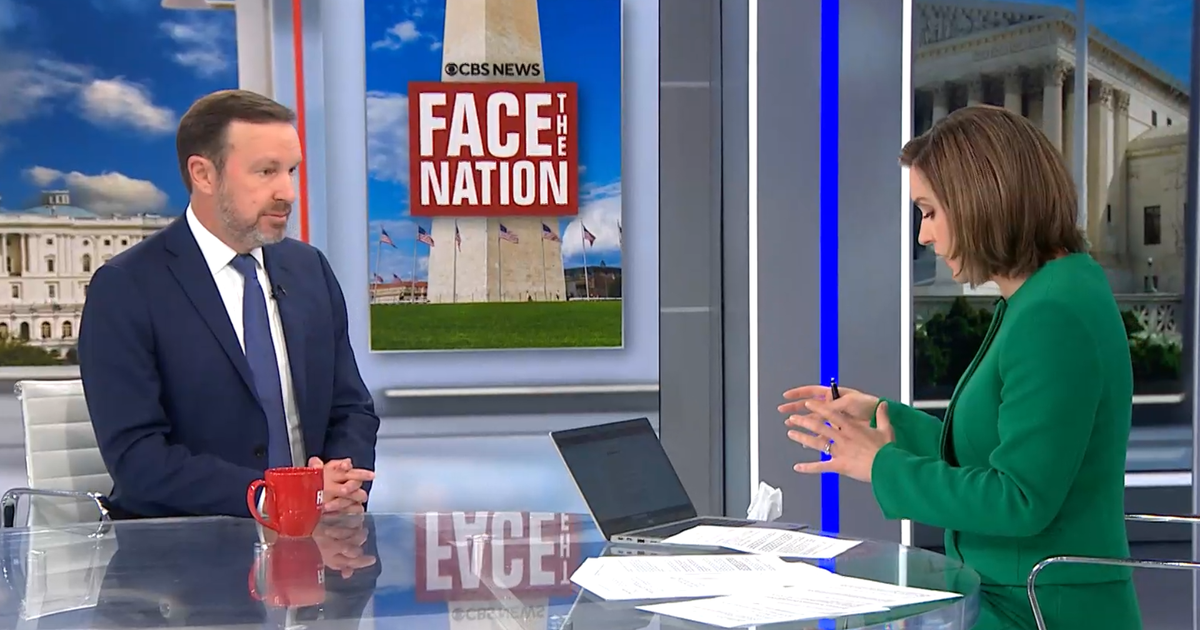
On this “Face the Nation with Margaret Brennan” broadcast, moderated by Margaret Brennan:
- Homeland Security Secretary Markwayne Mullin
- Sen. Chris Murphy, Democrat of Connecticut
- Senate Majority Whip John Barrasso, Republican of Wyoming
- Democratic New Hampshire Senate candidate Rep. Chris Pappas
- Shyam Sankar, chief technology officer of Palantir
Click here to browse full transcripts from 2026 of “Face the Nation with Margaret Brennan.”
MARGARET BRENNAN: I’m Margaret Brennan in Washington.
And this week on Face the Nation: President Trump scrambles to cut last- minute deals ahead of the midterms, the latest prompting backlash within his own party. Twenty-three days to go before the votes are counted, and the atypical campaign continues.
(Begin VT)
DONALD TRUMP (President of the United States): What the hell am I doing in Tennessee?
(End VT)
MARGARET BRENNAN: It’s a good question. The answer? Making sure his loyalists get out and vote Republican. Late Friday, Trump cut a deal with Vladimir Putin to import Russian diesel in an effort to lower the price of fuel in America.
(Begin VT)
PRESIDENT DONALD TRUMP: He’s freeing up a lot of oil for the world, OK? That’s a good thing.
(End VT)
MARGARET BRENNAN: But will Trump’s deal with Putin prompt even more Republican candidates to distance themselves from him?
We will ask the number two in the Senate, Wyoming Republican John Barrasso.
Democrats have their own challenges. How are they going to get their loyalists to turn out? We will talk with Connecticut Senator Chris Murphy and the Democratic nominee for Senate in New Hampshire Congressman Chris Pappas.
Then: ICE deportation tactics are back in the spotlight following an ICE- involved shooting in New York City. We will get the latest on that and an update on the aftermath of Hurricane Isaias from Homeland Security Secretary Markwayne Mullin.
Finally, another view on AI with the chief technology officer at Palantir, Shyam Sankar.
It’s all just ahead on Face the Nation.
Good morning, and welcome to Face the Nation.
We’ve got a lot of politics ahead, but we want to start with a quick update on the aftermath of Hurricane Isaias, which made landfall Friday night and resulted in the deaths of four people.
For that update, we turn to Homeland Security Secretary Markwayne Mullin.
Good morning to you, Mr. Secretary.
This is the first Atlantic hurricane of the year, hundreds of thousands of people left without power. I know the president approves some federal support. What is needed?
MARKWAYNE MULLIN (U.S. Homeland Security Secretary): Well, we – we’re in touch with the – with all the governors that are affected and might be affected by the continuing storm moving across the nation.
The president has been very involved in this from the get-go. Cam Hamilton, who is our director of FEMA, we started prepositioning assets into every state and working closely with their emergency responders.
Right now, from the conversation I have had with each governor, they’re in good shape. We’re – we have good partnership. What’s interesting about this area is, they’re – while they may not have been hit with storms real bad the last two years, they work really, really good together.
When I was talking to Governor Kemp from – you know, from Georgia, he was talking about his relationship with Ron DeSantis. When we’re dealing with the other governors, they were talking about how they’re cooperating with sending assets to the areas that are affected without power to get the – the power restored.
FEMA is standing by, responding with – with lifesaving responses. The Coast Guard is out in the inner waters and the Mississippi, the mouth of Mississippi, out in the – our shores. And we are still doing some boat rescues, but, really, it’s more recovery of the boats, not of the individuals.
So we’re working together well as a team. We were – you know, you never can be fully prepared for – for a storm like this, but I can tell you that the coordination from – from the Oval Office with President Trump’s leadership to the – to the governors to the county first responders…
MARGARET BRENNAN: Yes.
SECRETARY MARKWAYNE MULLIN: … we’re all working very closely together.
MARGARET BRENNAN: Well, we hope everyone in that pathway is safe.
I want to ask you about something else on the enforcement side of things. There have been at least 30 DHS officer-involved shootings under the Trump administration, according to CBS’s tally of events here. There was this incident last week in New York City.
And the NYPD did release security video that shows a man dressed as a civilian with a gun drawn approaching a car and then punching in the window. I know you have said there were other DHS ICE officers in the area who were put at risk by the driver.
But just to clarify events, when are you going to release the body cameras worn by those officers?
SECRETARY MARKWAYNE MULLIN: Well, Margaret, what you’re seeing is a pole cam.
What you’re not seeing is actual – the audio footage or a different angle, where you have multiple officers that are actually approaching this – this individual named Oscar with a long, very long, extensive rap sheet.
He’s only been in the country for – for three years, and he has a rap sheet of four charges of felony robbery, two charges of felony assault, felony larceny, misdemeanor assault, possession of – of weapons, possession of stolen property, two felony charges of drugless – of dangerous drugs, and strong gang affiliation that – that has direct or indirect knowledge of – of a CBP officer that was shot last year.
And this guy evaded officers last month when we tried to get to him.
MARGARET BRENNAN: OK.
SECRETARY MARKWAYNE MULLIN: We knew he was armed. We knew he was dangerous. We knew – or there was a possibility of him being armed. We knew he was dangerous, and we knew he was going to evade.
So when we approached his vehicle, we were giving lawful commands. We had approached him just like any other undercover agency that’s out there from local, state, federal or – or county that has undercover officers. We had our badges out, once again, giving lawful demands.
He decided that he was going to accelerate and try to evade again. We had taken every precaution to try to keep that from happening, and – and, unfortunately, this took place.
We would have loved for him to exit the vehicle like we asked him to. He decided not to. And, unfortunately, because of the selfish behavior, he put his 5-year-old at danger. But as far as…
MARGARET BRENNAN: You said they were wearing body cameras. Will…
SECRETARY MARKWAYNE MULLIN: … the information being released…
MARGARET BRENNAN: When will you release that footage?
SECRETARY MARKWAYNE MULLIN: As far – Margaret, as far as the information being released, FBI and HSI is going to do the investigation, continue to do the investigation. When it’s completed, we’ll release all the information.
MARGARET BRENNAN: OK.
There was that 5-year-old you just mentioned. Given that rap sheet and how long you’d been monitoring, how come those officers didn’t notice that a child was put in that car?
SECRETARY MARKWAYNE MULLIN: Well, what our understanding is, is, he drove into the neighborhood.
We knew his pattern of life, but we didn’t know the 5-year-old was in the vehicle. Who did know who the 5 – who was in the vehicle was Oscar. Now, as a father of six individuals – or six kids, I mean…
MARGARET BRENNAN: Yes.
SECRETARY MARKWAYNE MULLIN: … no way would I ever put my kids in danger. If I was getting lawful commands – and he knew he was being sought after. He knew the police was looking for him because, like I said, he just evaded a month ago.
MARGARET BRENNAN: Yes.
SECRETARY MARKWAYNE MULLIN: I would have immediately got out of my vehicle to protect my – my – my child.
There’s no way I would have been selfish enough to put my child in danger.
MARGARET BRENNAN: OK.
SECRETARY MARKWAYNE MULLIN: He was absolutely selfish enough to put his child in danger. He’s the one that decided to accelerate and – and ram into another vehicle with his 5-year-old in the vehicle, and then tried to accelerate towards other police officers.
MARGARET BRENNAN: Well…
SECRETARY MARKWAYNE MULLIN: That’s – that is – that tells you the type of character that Oscar is. And yet somehow the mayor is out there protesting about this.
MARGARET BRENNAN: Yes.
SECRETARY MARKWAYNE MULLIN: But yet, seven days ago, when an NYPD officer got stabbed in the same neighborhood by – by criminals that they released – by the way, Oscar had been released multiple times back onto the streets.
Not one time did the governor, not one time did the mayor have a press conference or talk about…
MARGARET BRENNAN: They did release a statement and visit the officer in the hospital.
SECRETARY MARKWAYNE MULLIN: … how awful it was that these criminals are stabbing NYPD officers.
That’s right.
MARGARET BRENNAN: But I think we’re all thankful, as I’m sure you are, that that 5-year-old was not harmed.
Let me ask you about something else, though.
SECRETARY MARKWAYNE MULLIN: Absolutely.
MARGARET BRENNAN: OK. Let me ask you.
SECRETARY MARKWAYNE MULLIN: It’s frustrating, though, Margaret…
MARGARET BRENNAN: Yes.
SECRETARY MARKWAYNE MULLIN: … because this guy should have never been on the streets…
MARGARET BRENNAN: OK.
SECRETARY MARKWAYNE MULLIN: … because we had asked – we had had a detainer on him and asked the – New York City to hand him over to us…
MARGARET BRENNAN: Yes.
SECRETARY MARKWAYNE MULLIN: … when they had him on – in – in their possession. He was on probation. He’s an illegal. He should have never been on the streets to begin with.
MARGARET BRENNAN: Let me ask you about another concern.
Secretary Hegseth said that he plans to livestream the upcoming execution by firing squad of convicted murderer Nidal Hasan, who killed 13 service members in 2009. Hasan’s in a wheelchair. Doesn’t the administration risk livestreaming this and making him a martyr to his cause? Couldn’t this be a risk to the homeland?
SECRETARY MARKWAYNE MULLIN: No one – no one has to watch it.
MARGARET BRENNAN: Well, then why are you livestreaming it?
SECRETARY MARKWAYNE MULLIN: But to – for me to have sympathy for anybody that killed 13 service members and a scumbag like this, it’s a psycho who was supposed to be a psychiatrist, I have no feelings for him at all. I don’t…
MARGARET BRENNAN: I’m not asking about him. I’m asking about the livestreaming and the risk that could be created by it.
SECRETARY MARKWAYNE MULLIN: Listen, once again, no one has to watch it if they don’t choose to.
MARGARET BRENNAN: Why livestream it?
SECRETARY MARKWAYNE MULLIN: I – I follow President Trump. He’s a the commander – he’s the commander in – in chief of the – of the country, and he does a phenomenal job.
He leads this country with a very, very, very direct, forward, straight hand, and he’s restoring America values and bringing us and bringing – where America should be back in line with what we want.
MARGARET BRENNAN: Your Republican colleagues Lisa Murkowski and Kevin Cramer have both said that this provides exactly what terrorists crave, an audience. It risks martyrdom.
Have you weighed the risk here of radicalization, of just creating a risk?
SECRETARY MARKWAYNE MULLIN: Margaret, we weigh – we weigh the risk every single day in this country. The Department of Homeland Security, that’s what we do, is we protect the homeland.
But I don’t see an elevated risk at this point at all because of this. I – I – I think people need to understand, if you attack – if you attack America, we will come after you, and we will make sure that the – that the punishment fits the crime.
MARGARET BRENNAN: Yes.
SECRETARY MARKWAYNE MULLIN: And, in this case, he killed 13 individuals on Fort – Fort Hood. I have no sympathy for him, and I give absolutely zero thought to the way that this man dies.
I – my job as secretary of homeland security is to protect the homeland.
MARGARET BRENNAN: Exactly.
SECRETARY MARKWAYNE MULLIN: And that’s what we do. And all 270,000 employees we do…
MARGARET BRENNAN: Yes.
SECRETARY MARKWAYNE MULLIN: Or that work in DHS do every single day.
MARGARET BRENNAN: Yes, that’s why I was asking about the homeland.
I want to ask you about another issue. Money that was allocated by Congress to Customs and Border Protection was used to purchase roughly $20 million in ads that have run on networks. One of the ads will be on this program as well. It’s touting President Trump’s accomplishments and also him personally.
There has been outcry from some Republican senators, including on this program last week. The president has since said his political action committee will pay for future ads. That’s taken care of. OK.
What about the past spending? Will U.S. taxpayers be reimbursed for the money that was spent on this?
SECRETARY MARKWAYNE MULLIN: Any time we can do a public service – announcement and brag about America, I’m all about it.
You have so much negative media that’s out there by fake media that’s constantly controversy, that, if it bleeds, it leads. I think 99 percent of the coverage on President Trump is negative. The majority of it is negative about our country and supposedly the direction that we’re headed.
MARGARET BRENNAN: So, no reimbursement of the $20 million?
SECRETARY MARKWAYNE MULLIN: But yet murder rates are down to a 126-year low. We have – we have the most secure borders in probably our nation’s history.
Fentanyl – fentanyl deaths are dropping.
MARGARET BRENNAN: Yes.
SECRETARY MARKWAYNE MULLIN: Drug seizures are dropping every – or drug apprehension is – is – is gaining speed every single day.
And we should be bragging about what’s happening inside America. I – I commend the opportunity to have the – I commend the opportunity of President Trump to give us the opportunity to brag about America.
MARGARET BRENNAN: OK, so no reimbursement.
Secretary Mullin, thank you.
SECRETARY MARKWAYNE MULLIN: Thank you, Margaret.
MARGARET BRENNAN: And we’re joined now by Connecticut Democratic Senator Chris Murphy.
Good morning.
SENATOR CHRIS MURPHY (D-Connecticut): Good morning…
MARGARET BRENNAN: Good to have you here in person.
Yesterday, there were 309 people injured, 12 killed, including one American, in this attack on the airport in Riyadh, Saudi Arabia. President Trump said the U.S. both may join strikes, but also that the U.S. is talking to the Houthis. That’s the Iran-backed group that carried out this strike.
Do you support retaliation? And do our Saudi partners, who you were just visiting, deserve the American support?
SENATOR CHRIS MURPHY: Yes, I was in that airport the day before, having visited the Saudis and the Qataris, who are trying to negotiate an end to the war.
I mean, listen, what I saw on the ground is a war that is spiraling out of control. You have a dozen dead, a full-blown new war between the Houthis in Yemen and Saudi Arabia. You have the Iranians restarting their missile programs.
They never – we never eliminated their drone program. They’re restarting a nuclear program. Gas prices are at $6 in some states.
MARGARET BRENNAN: They’re restarting their nuclear program? …
SENATOR CHRIS MURPHY: There’s evidence that it – one of the primary sites in which we think they are digging underground, they are restarting nuclear research activities.
Gas prices, diesel prices, food prices through the roof, 20 Americans dead, $100 billion spent. If the Trump administration was trying to lose this war, they couldn’t do worse than they are doing. This is a humiliation to the United States. The war is getting bigger and more dangerous, not smaller and more limited.
And it’s an advertisement for every single member of the House and the Senate who voted for this war, who continues to support this war to be booted out of office this November.
MARGARET BRENNAN: But, in regard to this particular strike, the U.S. has not committed to retaliating on our partners, the Saudis’ behalf. Do you think that that would be appropriate?
SENATOR CHRIS MURPHY: No, I don’t think the United States should go to war in Yemen.
I mean, this administration is absolutely incompetent in war-making. And so, just as we have made the Middle East worse and more chaotic by getting involved in a war against Iran, we would simply escalate and make the situation even more dangerous if we then went to war not only with Iran, but with the Houthis in Yemen as well.
MARGARET BRENNAN: Well, in many ways, there’s this argument about U.S. credibility in the region and continued presence.
The Congressional Budget Office says it’s unable to estimate the cost of damage to American bases because the Pentagon hasn’t provided the information and the extent of rebuilding is unclear. The extent is unclear because the intent is unclear. And some Democrats have even said they want to shrink the U.S. presence.
I believe you also favor drawing down the U.S. military presence. Are you going to vote to rebuild the installations you saw that were damaged?
SENATOR CHRIS MURPHY: Well, I didn’t see any installations. I mean, that’s the issue, is that we have no…
MARGARET BRENNAN: I thought you saw the embassy that was…
SENATOR CHRIS MURPHY: Well, I saw the embassy.
MARGARET BRENNAN: OK.
SENATOR CHRIS MURPHY: But the most expensive rebuild would be of the naval base in Bahrain and our air base in Qatar. And, right now, members of Congress are being denied the ability to see the damage at these bases because there is a cover-up under way.
There is a cover-up under way to try to hide from the American public the cost of this war and the debacle that it has caused in the region. So how could we assess whether we want to rebuild these facilities if the administration is denying us the ability to see them or even to understand the scope of the damage?
I mean, the – the blockage of basic congressional oversight responsibilities here is absolutely egregious.
MARGARET BRENNAN: You said that you had evidence shared with you of possible rebuilding of Iran’s nuclear program. Was that a classified briefing? Was that a briefing that the administration did share with you?
SENATOR CHRIS MURPHY: No, that’s open-source reporting…
MARGARET BRENNAN: OK.
SENATOR CHRIS MURPHY: … that the Iranians are potentially starting to dig deeper to rebuild some of the capacity.
MARGARET BRENNAN: Pickaxe Mountain. Pickaxe.
SENATOR CHRIS MURPHY: Pickaxe Mount…
MARGARET BRENNAN: OK.
SENATOR CHRIS MURPHY: Pickaxe Mountain.
MARGARET BRENNAN: OK, because the Pentagon does say they need additional funds for the war we are currently in with Iran. How do you balance the political statement and the intent to end it against the question of whether we are supporting and protecting our people who are still in the region?
SENATOR CHRIS MURPHY: Yes, the best way to support our troops and our people in the region is to end this war, to unilaterally end American hostilities, and to, frankly, ask our partners in the region to do the work of reopening the strait and reopening the Red Sea.
The reality is, so long as the potential continues for…
MARGARET BRENNAN: Just walk away?
SENATOR CHRIS MURPHY: Well, for – the president is saying that he is considering, after the election, going back to war with Iran. And so, of course, Iran’s response to that is going to be an escalation of the war.
The president needs to bring this war to an end, and that will be the quickest way that the waterways will be reopened. Again, this is a president who is showing just humiliating levels of incompetence in war- making, and escalation is just going to bring more misery for the American taxpayers and for people who live in that region.
MARGARET BRENNAN: Just to put a fine point on it, I mean, the Iranians want the U.S. to withdraw from the region. Do you favor a drawdown of U.S. troops from the region?
SENATOR CHRIS MURPHY: Well, I think the United States is always going to have to have a presence in that region.
But let’s just be honest. We don’t have a naval base any longer in Bahrain. We don’t have an effective base in Qatar because, minutes into the war, the Iranians took those bases out. So, at the very least, if we’re going to rebuild any capacity in that region, we’re going to have to find a way to protect it.
Donald Trump was so fundamentally unprepared for this war that, within days of the war starting, our billion-dollar air bases and naval bases in the region were obliterated by the Iranians. Every single American should be furious about that, not just because Americans died, but because their taxpayer dollars at scale were wasted.
And so, yes, we should reconsider whether we should rebuild them if we can’t protect them. And this president is incapable of protecting our people in the Middle East.
MARGARET BRENNAN: The Pentagon did disclose yesterday 20 fatalities, American fatalities.
SENATOR CHRIS MURPHY: Extraordinary.
MARGARET BRENNAN: I want to ask you a bit about politics.
Our CBS polling shows Republicans, they do have perhaps a turnout problem compared to Democrats. But when it comes to perception, 58 percent of registered voters polled by CBS say they view the Democratic Party as weak. What is the affirmative Democratic message, other than, we’re not Trump?
SENATOR CHRIS MURPHY: Well, I mean, listen, we are in the middle of a war that is a disaster for the American people. I mean, people can’t afford food. They can’t afford to fill their gas tanks. Farms are going bankrupt in the Middle East at a record rate.
So let’s just be honest. The most important thing that the American people are thinking about right now is getting these people out of power, because this has been a disaster for the world, for America’s reputation and for the economy.
But, yes, I think we need to be bold in our ideas and our proposals for how we’re going to fix this mess. And so we should promise that, if we win this election, we are not going to fund this war, right? We’re not going to approve money for the Department of Defense without a commitment from the Trump administration that this war ends.
We’re going to take on this corruption, not just Trump’s corruption, but the entire corruption of the federal government. If you elect us, we’re going to work to get billionaire and corporate and anonymous money out of politics.
To the extent that people see us as weak, I think, historically, it’s been because our ideas haven’t been big enough, our tactics haven’t been bold enough. And, yes, in the closing days of this campaign, we can promise people, if you elect us, we are going to take on his corruption, we are going to end this war.
And that supplemented with the higher prices and the debacle…
MARGARET BRENNAN: Yes.
SENATOR CHRIS MURPHY: … of the war with Iran, I think could result in a landslide.
MARGARET BRENNAN: You’re hitting the trail, as I understand it, North Carolina, Florida, Michigan, Minnesota. You’re going to help out one of our other guests in New Hampshire.
But let me ask you about the Florida decision. The Senate candidate, Angie Nixon, there has aligned herself with democratic socialists over the summer. Does that give you pause at all? Or when you talk about big ideas, is that the kind of big idea you want to endorse?
SENATOR CHRIS MURPHY: Well, I also think we should just be a big tent, right? There’s, I think, a pretty big difference between Chris Pappas in New Hampshire and Angie Nixon in Florida.
And if we want to win elections, we should welcome people who have a diverse set of ideas into the party. The people of Florida…
MARGARET BRENNAN: But then you’ve got to govern.
SENATOR CHRIS MURPHY: Well, the people of Florida will decide, right, right, whether they want Angie Nixon or whether they want Senator Moody, who has basically said nothing about the growing massive corruption scandals in this administration.
But, as a party, I think we should welcome a lot of different people with a lot of different ideas in and then let the voters decide.
MARGARET BRENNAN: Senator Murphy, thank you for your time today.
SENATOR CHRIS MURPHY: Appreciate it.
MARGARET BRENNAN: Face the Nation will be back in a minute. Stay with us.
(ANNOUNCEMENTS)
MARGARET BRENNAN: And we turn now to Senate Republican Whip John Barrasso, who joins us from Casper, Wyoming.
Good morning to you, Senator.
SENATOR JOHN BARRASSO (R-Wyoming): Well, it’s great to be here in Wyoming.
I will be hitting the trail again tomorrow. It was interesting listening to Chris Murphy ignoring the craziness of the Democrat candidates for the Senate, and that’s why I’m going to be out talking about the difference between the commonsense Republicans who I’m supporting and our party is…
MARGARET BRENNAN: Yes.
SENATOR JOHN BARRASSO: … and the crazy Democrats who’ve been nominated and are now causing the direction of their party to go way to the left.
MARGARET BRENNAN: Well, I understand you are headed to Midwest and the West.
Of the 10 Senate battleground races CBS is tracking, six are Republican- held seats. How challenging is this midterm going to be for your party?
SENATOR JOHN BARRASSO: Well, I’m optimistic with opportunities to pick up seats, New Hampshire, Michigan, Minnesota.
You talk about corruption. That’s what we’re seeing in Minnesota in their state run by the – the Democrats. In Michigan, I don’t know if you saw the debate this past week. El-Sayed was on, the Democrat nominee for the Senate in Michigan, against Mike Rogers.
He was asked, who’s more of a threat to the United States, Iran or Israel? He could not answer and refused to answer the question. Everyone in the world knows that Iran is much more of a threat to the United States. They chant, “Death to America.”
Israel is our friend and ally. He would not admit it. Iran is at war with the United States. They’ve been killing Americans for 50 years, and the candidate in Michigan is so extreme that he will not even admit the reality of what the American people see.
MARGARET BRENNAN: Well, the Republican candidate in Michigan has tried to distance himself from the very war you’re talking about, though. Mike Rogers has talked about the Iran war has got to end. He’s acknowledging that the high fuel prices related to it are a problem for him. How do you explain that?
SENATOR JOHN BARRASSO: Well, everyone wants the war to end. Everyone wants fuel prices to come down who’s a Republican. Democrats don’t seem to want fuel prices to come down.
They like high fuel prices. They were a lot higher when Biden was in office than they are today. And when you look about the lawsuits that the Democrats are bringing, you look about the fact that, in California, this past year they shut down two refineries, they are against fossil fuels.
MARGARET BRENNAN: Well…
SENATOR JOHN BARRASSO: Last week, at the Supreme Court, there was a lawsuit to say…
MARGARET BRENNAN: Yes.
SENATOR JOHN BARRASSO: … we want to sue. They do. The Democrats sue oil companies for making gasoline because they say it contributes to climate change.
MARGARET BRENNAN: Well, that’s in Colorado.
SENATOR JOHN BARRASSO: Democrats want high gas prices. They want us in electric vehicles.
MARGARET BRENNAN: Yes.
SENATOR JOHN BARRASSO: And that’s – that’s the difference.
MARGARET BRENNAN: Yes.
SENATOR JOHN BARRASSO: That’s the difference between commonsense…
MARGARET BRENNAN: OK.
SENATOR JOHN BARRASSO: … Republicans and these crazy Democrats who’ve been nominated all around the country.
MARGARET BRENNAN: Well, Senator, I don’t – I don’t mean to cut you off. I want to let you finish this in a minute when we have more time.
So, stay with us while we take the commercial break, and we’ll talk on the other side.
(ANNOUNCEMENTS)
MARGARET BRENNAN: Welcome back to “FACE THE NATION.”
We return now to our conversation with Senator John Barrasso of Wyoming.
Senator, we’re talking about those upcoming midterm races, and the pressure of higher fuel prices. We saw President Trump, on Friday, announce he’s going to start importing Russian diesel fuel to help American farmers, ranchers and truckers, as he put it. Congress banned Russian energy imports back in 2022, and even more recently they’ve put in place more possible financial penalties to the buyers of Russian oil. Doesn’t the president’s action violate the laws? And how do you justify giving Vladimir Putin a lifeline?
SENATOR JOHN BARRASSO (R-WY): Well, the president is focused on getting down the cost of energy. He’s focused on ranchers, farmers, truckers, as you said. I’m right in the middle of that here in Wyoming. This is cattle country. I heard it last night in an event that I was at. The high diesel prices that are impacting everyone. The president is balancing and has to make tough decisions. He’s balancing his effort to stop and end the war of – Putin’s war in Ukraine, and lowering prices for American families.
What we really need to do long term is produce more American energy, but we’re running into a problem with the Democrats who want us to produce less American energy and want high energy prices. So, I know what the president is trying to do. I agree, we need to lower prices. And the problem is, the Democrats are blocking us long term from doing what’s going to be best for the American people.
MARGARET BRENNAN: Well –
SENATOR JOHN BARRASSO: We all want this war to end. We want to do it as quickly as possible in a way that Ukraine is protected with long term peace and that energy prices come down. And the sooner that happens, the safer America will be and the lower prices will be for American consumers.
MARGARET BRENNAN: Yes. But letting Russia sell oil would seem to put money and more mobility to Vladimir Putin and not necessarily make a dent in diesel prices, according to most energy analysts that I’ve read.
Former Vice President Pence said, “the decision to lift sanctions on Russian fuel makes no sense and is a betrayal to the legacy and leadership of the late Senator Lindsey Graham.” He’s talking about the Graham law you voted for. And I know you’ve got to make a decision by October 18th, at least the president does, about putting in place the powers you helped to give him to punish buyers of Russian oil. Doesn’t the president’s action make a mockery of that law you just passed?
SENATOR JOHN BARRASSO: We passed that law to give the president the flexibility and the firepower to use another tool against Vladimir Putin. We want to end this war. We want to get fuel prices down. The president wants that as well. This is just another point of leverage for the president to use against Putin in an effort to get a long-term solution in that – in that part of the world.
So, I wanted to – I voted for that law, and the president signed that law, and he needs to use that because he now has the flexibility to do it in the best interest of world peace and lower energy prices here in America.
MARGARET BRENNAN: I want to ask you about your role on Senate Foreign Relations. You have oversight there. “The Wall Street Journal” has had a series of reports about the U.S. ambassador to Greece, Kimberly Guilfoyle. Can you confirm at all that there’s an investigation on some level into her actions, perhaps an inspector general probe if not something more, on the ethics front?
SENATOR JOHN BARRASSO: Well, what we’ve seen in the reports is very troubling. It’s concerning. And I’m sure there’s going to be an investigation. I would assume the State Department would be conducted that. I know that the Senate Foreign Relations Committee will have oversite and look into that as well. But I think the public has a right to know what was – what is found, and it is quite a bit of concern.
MARGARET BRENNAN: Yes. I mean among the things that were made public by a Trump donor were text messages in which she asked him to give her $100,000 to pay off credit card debt and asked not to put some of these things in writing because it could endanger her job.
Are you comfortable with any U.S. official asking someone to pay off debt in exchange for access to government officials?
SENATOR JOHN BARRASSO: No, I’m not. And, you know, we’re going to be back after the elections. But for the next three weeks, we’re going to be out campaigning across the country. And I’m sure we’ll discuss that later.
But the focus today is making sure that the American people know just how far to the left the Democrats have gone. And they are now the party, and they have – they have a manifesto, and you highlighted one of the candidates from Florida, the Democrat nominee in Florida.
MARGARET BRENNAN: Yes.
SENATOR JOHN BARRASSO: They want to eliminate Immigrations and Customs Enforcement, open the border. They want to open the prisons, put these people into our communities. They want to defund the military, defund the police, raise taxes to pay for health care for illegal immigrants and have boys in girl’s locker rooms.
MARGARET BRENNAN: Well –
SENATOR JOHN BARRASSO: And when you were on with Murphy, and you asked about the military –
MARGARET BRENNAN: Yes.
SENATOR JOHN BARRASSO: The Democrats have blocked the National Defense Authorization Act.
MARGARET BRENNAN: Yes.
SENATOR JOHN BARRASSO: He says, well, we ought to not fund things.
MARGARET BRENNAN: Well –
SENATOR JOHN BARRASSO: This is the first time in 65 years that we’ve not passed a National Defense Authorization Act, which funds the military and makes sure they have what they need –
MARGARET BRENNAN: Yes.
SENATOR JOHN BARRASSO: To be able to be the war fighters that they are.
MARGARET BRENNAN: Yes.
SENATOR JOHN BARRASSO: And yet the Democrats are all voting no on supporting our troops.
MARGARET BRENNAN: Well, he said that he did want more information. He said that briefings weren’t being shared, details weren’t being shared. So, approving money without those briefings is something he said he was not willing to do. Would you ask the administration to be more forthcoming and give details, including on these damage to bases?
SENATOR JOHN BARRASSO: Well, you’re talking appropriations. I’m talking about the actual authorization act to get – make sure the military has what they want.
MARGARET BRENNAN: Got it.
SENATOR JOHN BARRASSO: The Democrats in the Senate are so afraid of these candidates who have won nominations and primary elections that when those candidates and their manifesto calls for defunding the military, all of the Democrats in the Senate voted against the National Defense Authorization Act. And that’s just wrong.
MARGARET BRENNAN: Well, Senator Barrasso, we will watch what you get done in – on the campaign trail and when we get back to work in November. Thank you for your time.
We’ll be right back.
(ANNOUNCEMENTS)
MARGARET BRENNAN: We turn now to Congressman Chris Pappas, who’s running for the U.S. Senate in his native New Hampshire. He joins us this morning from Manchester.
Good morning.
REPRESENTATIVE CHRIS PAPPAS (D-NH): Hi, Margaret. Good morning.
MARGARET BRENNAN: Well, CBS projects that New Hampshire is no longer a toss-up but lean Democrat. So, what are you focused on in these final weeks of the campaign?
REPRESENTATIVE CHRIS PAPPAS: Well, we’re taking nothing for granted in this race because New Hampshire’s a purple state. And we’re an all election day state where we don’t have early voting generally in New Hampshire. So, it’s focused on how we get to those independent swing voters, how we energize the base, how we reach out to Republicans of the next 23 days, to win a tough race.
Our Senate race in 2016 in New Hampshire was decided by 1,017 votes. I’m up against a candidate with a very famous political pedigree in New Hampshire. He’s been a U.S. senator before.
But this isn’t about going back to the failed politicians with failed ideas from the past. It’s about looking ahead to the future. How we muster the courage to stand up to a reckless administration that’s making life more expensive, how we fight to lower costs.
MARGARET BRENNAN: Yes.
REPRESENTATIVE CHRIS PAPPAS: How we connect with everyday granite staters about the kind of future we can build together.
So, I’m hopeful about where we’re going to end up at the end of this thing, but we’ve got to put in the work over the next 23 days in order to change things in Washington and deliver the results New Hampshire deserves.
MARGARET BRENNAN: Well, Democrats do seem nationally to be running on an anti-Trump agenda in your particular race. You mentioned John Sununu, you’re opponent. He doesn’t make that strategy easy because he used to be a never Trumper, he criticizes the trade war with Canada, he doesn’t like Trump sending $5,000 checks out. He said it was a mistake to start the war with Iran without a strategy for the Strait of Hormuz. I mean he has distanced himself in some ways for the president, though he is endorsed by Mr. Trump.
How do you split that in the minds of the Republicans that you are trying to win over?
REPRESENTATIVE CHRIS PAPPAS: John Sununu has said it out loud. He said that this race is important to Donald Trump’s agenda, and to protect the gains that Donald Trump has made for the American people. You know, I don’t know what those gains are, because if you were paying $1,000 to fill up your home heating oil tank, or $6.50 to put diesel in your car for every gallon, or housing costs that are through the roof, you’re not feeling like you’re winning right now.
So, the fact is, Donald Trump has said this, that pretend I’m on the ballot.
MARGARET BRENNAN: Yes.
REPRESENTATIVE CHRIS PAPPAS: He’s on the ballot through candidates like John Sununu, who will maintain his majority in the U.S. Senate, will make it harder for us to hold this administration to account, to address the culture of corruption in Washington and fight to lower costs for New Hampshire families.
So, John Sununu stands with Trump in this campaign. He’s been supporting his agenda. The fact is, the last time he was in office, he stood with George W. Bush for forever wars, privatizing Social Security and tax cuts for the rich. That didn’t work for New Hampshire then and he doesn’t represent the kind of future we need to lower costs and get this economy working for everyone.
MARGARET BRENNAN: But if Democrats flip control of Congress, what specifically does the party want to do to stop Mr. Trump, as you just laid out? I mean is that impeachment? Is that investigation?
REPRESENTATIVE CHRIS PAPPAS: Certainly there has to be accountability. And the American people deserve to know what’s going on in the government. And any sort of corruption has to be rooted out. But we have to focus like a laser on the economic challenges that people are living right now. We have to put some wins on the board for workers and the middle class.
MARGARET BRENNAN: How do you do that?
REPRESENTATIVE CHRIS PAPPAS: We can do that by building on the success of the housing bill that we passed to invest in the affordable housing stock that we need, to work to end this war and lower energy prices, to restore the cuts to health care that are kicking thousands of granite staters off of their health insurance, and making it harder for people to access the care that they need.
So, we do have to focus with everything we’ve got on the affordability agenda that starts in January. And I think that’s both a short, medium, and long term strategy to take on the way this economy has been rigged and deliver results for middle class families and workers.
MARGARET BRENNAN: You said restore cuts to health care. I think you mean in – the enhanced premium subsidies. So you want more government spending on healthcare? Is that your platform?
REPRESENTATIVE CHRIS PAPPAS: I want New Hampshire families to be able to get a health care premium that makes sense for them, that will allow them to provide for their families. Seventeen thousand folks in my state have dropped their insurance because of the failure to extend the ACA premium subsidies.
MARGARET BRENNAN: Yes.
REPRESENTATIVE CHRIS PAPPAS: And we’re looking at a huge cut with respect to Medicaid that’s going to devastate our hospitals, health centers and nursing homes, cynically timed to kick in just after this election.
MARGARET BRENNAN: Well –
REPRESENTATIVE CHRIS PAPPAS: So, it’s a focus both on making the Affordable Care Act work, taking the insurance companies and pharmaceutical companies to account to lower prices, and making sure we’re backstopping these cuts to Medicaid so that rural health care, health care for people in underserved areas doesn’t get disrupted and, you know, destroyed by these MAGA cuts that were a part of the big, beautiful bill last year.
MARGARET BRENNAN: Well, if Democrats do take control, there’s also going to be that question of what is the unified vision for the party, and can you unify your party? There’s been a lot of focus on ICE, Immigration, and Customs Enforcement. You sponsored a bill that would redirect $75 billion in ICE funding to local law enforcement agencies. You say ICE needs reform. That’s different from some of your Democratic colleagues who are saying, disband ICE entirely, including just right next door in Maine, where Troy Jackson, who’s running for Senate, says you’ve got to break it up. Why is he wrong? Why is your approach the way to go?
REPRESENTATIVE CHRIS PAPPAS: Well, we have to be realistic. Donald Trump’s going to be president for the next two years. We’ve got to find every point of leverage we possibly can to reign in the disgusting abuses we have seen from ICE. From next door in Biddeford, Maine, to Minneapolis, to Texas, this is unacceptable to people in New Hampshire, and it’s unacceptable to voters across the political spectrum.
So, we need accountability. We need to take back the extra money that they were given in that slush fund last year. $75 billion with no stringing attached by Congress, with no meaningful oversight. We need to make sure that ICE officers are conducting themselves like our trusted local law enforcement does, making sure that they’re identified, that they’re – have deescalation training, that they have body cameras. All of that would be a step in the right direction.
But the fact is, this is a nation of immigrants. And we have to make sure that we are going after the worst of the worst.
MARGARET BRENNAN: Yes.
REPRESENTATIVE CHRIS PAPPAS: Criminals that are violating the law. While also respecting due process rights and making sure that immigrants are a part of our extended American family.
MARGARET BRENNAN: OK.
REPRESENTATIVE CHRIS PAPPAS: And people in New Hampshire support that. And I hope we can get to the point where we’re talking about immigration reform that will allow immigrants to follow a path to work hard, to earn their citizenship –
MARGARET BRENNAN: Right.
REPRESENTATIVE CHRIS PAPPAS: And to ensure that our businesses can benefit from that.
MARGARET BRENNAN: Right. And then you’d have to work with a Republican president on those things.
Thank you very much for your time.
We’ll be back in a moment.
(ANNOUNCEMENTS)
MARGARET BRENNAN: For another perspective on artificial intelligence, we spoke Friday with Shyam Sankar, the chief technology officer for the software company Palantir. We spoke about how the rapidly advancing technology should be regulated.
(BEGIN VT)
MARGARET BRENNAN: Fifty percent of those polled by CBS say A.I. will create more problems than it solves, 29 percent say it will solve more than it creates, and 21 percent just really don’t know. Like, 45 percent of Americans want the government to restrict use and development of A.I.
Is your position there should not be any guardrails at this moment?
SHYAM SANKAR (CEO, Palantir Technologies Inc.): No, not at all. That’s not my position.
I think the burden is absolutely on the technology industry to show the American people that there are real benefits to A.I. and not kind of ephemeral sort of benefits, like it can help me schedule travel, but actually meaningful benefits that result in job growth and prosperity for the American people. I think one of the things that’s really complicated in the current discussion is that there’s an unseen force driving the narrative around A.I. safety. And it’s really this millenarian, doomsday cult meets messiana (ph) complex called effective altruism.
MARGARET BRENNAN: The other part of this argument would be the people who don’t want guardrails are simply in it for commercial reasons. They want to keep selling chips or they just want access to market. So, that would be the counterargument to the idea that, you know, what you’re saying, which is an ideological opposition to guardrails.
SHYAM SANKAR: You know, make we could just back up. And who’s on the side of no guardrails?
MARGARET BRENNAN: Well, when – I want to get into the specifics here because even just defining what guardrails is seems really complicated and there’s not even common agreement on that right now. But Jay Clayton, who is the new DNI and the new A.I. czar, said this week the focus is on control and monitoring of technologies with the potential to do harm. So, what does that look like to you? Because it sounds like he’s not even sure yet.
SHYAM SANKAR: Well, I think there’s a very clear view that we should be regulating the application of the technology. So, if you’re going to use this in medicines, you know, the FDA, we – as a republic, we have 250 years of rich laws and history on how to manage liability. I don’t want to trivialize the metaphor, but, you know, if I buy a car and the car is defective, that’s the car-maker’s problem. If I then use that car to go drive into my neighbor’s house, that’s my problem and, you know, this sort the obfuscation that the narrative is, this technology is a total difference of kind. I don’t think so. I think it’s a difference of degree. It –
MARGARET BRENNAN: Well, in that, humans aren’t in control of it. It would be a different kind.
SHYAM SANKAR: It – no, humans are in control of it. Even if we look at the kind of salacious reporting around Hugging Face, the models did not do anything they were not instructed to do. You know, they were – the real – first, you have human error. They were not in the sandbox. They had access to the internet. It was a horrible cybersecurity configuration. Then from that perspective, they were asked to succeed a specific benchmark, and they were not given constraints on how to do that. And they said, oh, the best way to succeed at the benchmark is to get the answers to the test, and to do so.
MARGARET BRENNAN: So, for that, who should take action to –
SHYAM SANKAR: I think it’s a defective product. Like, if you were going to sell that.
MARGARET BRENNAN: But is it up to the Justice Department to then bring suit like on the programmers? Like, who’s liable for the technology not, you know, staying within the sand box?
SHYAM SANKAR: The A.I. companies, of course. In that – in that specific case it would be the A.I. companies. If another company had licensed that technology to use in another –
MARGARET BRENNAN: Yes.
SHYAM SANKAR: In an application, and the product worked as expected but you misused the product, then it would be you that are responsible for that.
MARGARET BRENNAN: So, you believe that the existing laws on the books should be able to handle technology as it develops?
SHYAM SANKAR: I think it is a massive running head start. I think the laws on the books speak to a lot of the current considerations. Might we need a few more things on the margin? Sure. But I think we’ll figure that out as we go through it.
MARGARET BRENNAN: So, let’s talk about some of those things, because you were with the president when he summoned some of these A.I. leaders recently. And he asked them all to sign a pledge to “implement robust internal controls, partner with an external auditor and establish a committee to evaluate reports from auditors.” That was Google, Anthropic, OpenAI, Nvidia, Elon Musk. They all signed it. Palantir, your company, didn’t. Why?
SHYAM SANKAR: Those accords were for companies that actually make A.I. models, which we do not. so –
MARGARET BRENNAN: But you help to use them and build out platforms. Like, you don’t see a reason for constraints there?
SHYAM SANKAR: We do have those constraints. In fact, part of that’s our entire business is, how do you safely deploy these models in specific use cases. We’re just not a part – we weren’t asked to be a part of the accord.
MARGARET BRENNAN: But you were there at that meeting.
SHYAM SANKAR: I was.
MARGARET BRENNAN: So, what happened? Like, what was the conversation?
SHYAM SANKAR: Well, the conversation was really an assertion that the American people expect A.I. to generate economic prosperity and to do so securely and that we, as companies, have an affirmative obligation to deliver on exactly those things. And that we have existing laws to look at this and that we should be all taking this quite seriously. It was a very productive conversation.
MARGARET BRENNAN: Because it sounded like the White House was saying something more should be done. And now you have this new A.I. czar, Jay Clayton, going out to Silicon Valley this week. He said he’s launched this 20-day review of A.I. policy. What do you hope comes of that? Or is this another one of these like blue ribbon commissions that doesn’t produce anything?
SHYAM SANKAR: No, I think a lot will come up to it, which is really focused on energy and using the existing agencies and regulatory apparatus to make sure we’re on top of this stuff and providing support where it’s needed.
I think one of the challenges, going back to my comments in effective altruism is today the so-called independent research organizations that are overseeing this are not really independent. They have conflicts with the labs. They are made up of people with a singular world view around affective altruism, looking for the doomsday scenarios. You know, you have evaluates who are essentially pointing a loaded gun at a target saying, I can’t believe the gun worked, when they should really be saying, what guardrails do we have in place? Are – you know, are these products working to the specification we’ve designed and what are the opportunities for misuse?
MARGARET BRENNAN: Don’t you think within the current institutions there could be some sort of entity that oversees technology?
SHYAM SANKAR: I think there’s going to need to be an incident response and reporting regime that creates more visibility and transparency into what you’re learning in the testing well ahead of product launches, that give visibility and transparency to the government of how people are doing at implementing exactly the existing laws.
MARGARET BRENNAN: You have said recently that “the war in Iran is the first major conflict where A.I. played a central role, particularly for targeting.” Do you see risks for that?
SHYAM SANKAR: Targeting is this – is kind of this very salacious word. Really, targeting is a process. And if you think about military operations, the ability to execute a thousand strikes in a single day would have taken two weeks of planning by 50 people before. And being able to do that with one person in four hours provides you a significant battlefield advantage against your adversaries.
And so it’s really not about, you know, people jump immediately to something like A.I. picking the targets. That’s not what’s happening. It’s really, given a set of effects that you want to create, I want to be able to take out the enemy’s air defenses. OK, what targets relate to that? OK. How do I then push them through a process where I understand, are any of these targets on the no strike list? Are any of these targets to close to civilian infrastructure?
MARGARET BRENNAN: Yes. Well, that goes to a broader argument about the elimination of some of the people who were involved in mitigating civilian impact from strikes. That was a Pentagon decision by Secretary Hegseth. And there were so many successful strikes in terms of the targeting in Iran, but there was also, as you know, this horrific one in Minab (ph) that killed at least 123 school children. “Bloomberg” reported some personnel relied too much on the A.I. in the Maven system made by Palantir using A.I.-enabled software. Have you determined what happened there?
SHYAM SANKAR: Well, we should wait for the final report. But what I can say is, that reporting’s inaccurate.
MARGARET BRENNAN: The reporting from “Bloomberg” you’re saying is inaccurate?
SHYAM SANKAR: Yes, it’s inaccurate. And actually, the likely cause is human error. And then – and quickly following that, we actually built additional A.I. agents that did more checking. That’s part of the process we don’t own.
But responding to the urgency of the moment, we built additional A.I. that actually double checks more of the work outside the process that we own to ensure things like that couldn’t happen again.
MARGARET BRENNAN: So, you’re suggesting it was outdated intelligence or human error that fed information into the computer system? Is that what you’re saying?
SHYAM SANKAR: Well, we should wait for the final report, but I think we will find –
MARGARET BRENNAN: Do you know when that will be released?
SHYAM SANKAR: I don’t.
MARGARET BRENNAN: Because the initial reports have been widely reported on, including on by this network. Do you see harm in that being made public soon, or is it helpful to what you say are improvements you want to make?
SHYAM SANKAR: Well, I will defer to the department on the – on the timing of that. I have no control over that. But, yes, I would love the truth to get out there.
(END VT)
MARGARET BRENNAN: Our full conversation is on our website and our YouTube channel.
We’ll be right back.
(ANNOUNCEMENTS)
MARGARET BRENNAN: Our Norah O’Donnell spoke to Secret Service Director Sean Curran for tonight’s “60 MINUTES.”
Here’s a preview.
(BEGIN VC)
NORAH O’DONNELL: How would you describe the current threat environment in this country?
SEAN CURRAN, DIRECTOR, U.S. SECRET SERVICE: It’s like we’ve never seen before. The threats on our full-time protectees are up just over 40 percent since they – than they were last year. That’s a massive increase.
O’DONNELL: Sean Curran is the 28th director of the United States Secret Service. He told us, since January, there have been 10,000 threats on the people they protect.
(END VC)
MARGARET BRENNAN: “60 MINUTES” airs tonight on CBS and Paramount Plus at 7:00 p.m. Eastern.
As for us, we’ll see you next week. For “FACE THE NATION,” I’m Margaret Brennan.
(ANNOUNCEMENTS)