Introduction: Moving PAT From Concept to Reality
Why Bioprocesses Need Real-Time Monitoring
Spectroscopy Techniques Used in Modern PAT
Raman Spectroscopy
Near-Infrared (NIR) Spectroscopy
FTIR Spectroscopy
Fluorescence Spectroscopy
Where Spectroscopy Delivers Value on the Manufacturing Floor
From Data Collection to Process Control
What Still Limits Adoption?
Future Directions for Spectroscopy-Based PAT
References and Further Reading
Spectroscopy-based process analytical technology combines real-time sensing, chemometric modeling, automation, and predictive analytics to improve bioprocess monitoring and control. Raman, NIR, FTIR, and fluorescence techniques offer complementary capabilities, while calibration, integration, validation, and regulatory requirements remain important barriers to wider implementation.
 Study: Kallayanee Naloka/Shutterstock.com
Introduction: Moving PAT From Concept to Reality
Process analytical technology (PAT) enables real-time monitoring and control of manufacturing processes. By complementing conventional off-line sampling with timely at-line, on-line, and in-line measurements, spectroscopy-based PAT allows manufacturers to detect process changes early, reduce variability, and make timely adjustments before product quality is compromised. Growing demand for higher product quality and productivity has accelerated development of PAT tools for real-time monitoring and process control.1,2
The International Council for Harmonization (ICH) defines Quality by Design (QbD) as a systematic approach emphasizing process understanding, control, and quality risk management. The United States Food and Drug Administration (FDA) defines PAT as a system for designing, analyzing, and controlling manufacturing through timely measurements of critical process parameters and/or quality attributes. This system supports QbD implementation and can facilitate real-time release (RTR). PAT integrates in-line, on-line, and at-line technologies to provide timely process visibility in biologics manufacturing. Spectroscopy is among the most widely adopted PAT tools.2,3
Why Bioprocesses Need Real-Time Monitoring
The inherent complexity of therapeutic proteins may be due to their higher molecular weights, multiple post-translational modifications (PTMs), higher-order structure variants (HOS), and/or putative molecular interactions. Their analysis creates a need for rapid analytical tools capable of monitoring relevant process parameters and quality attributes. Traditional off-line sampling delays process decisions. These delays are among the factors driving interest in continuous manufacturing and intensified bioprocessing, in which unit operations can be more closely integrated.2,3
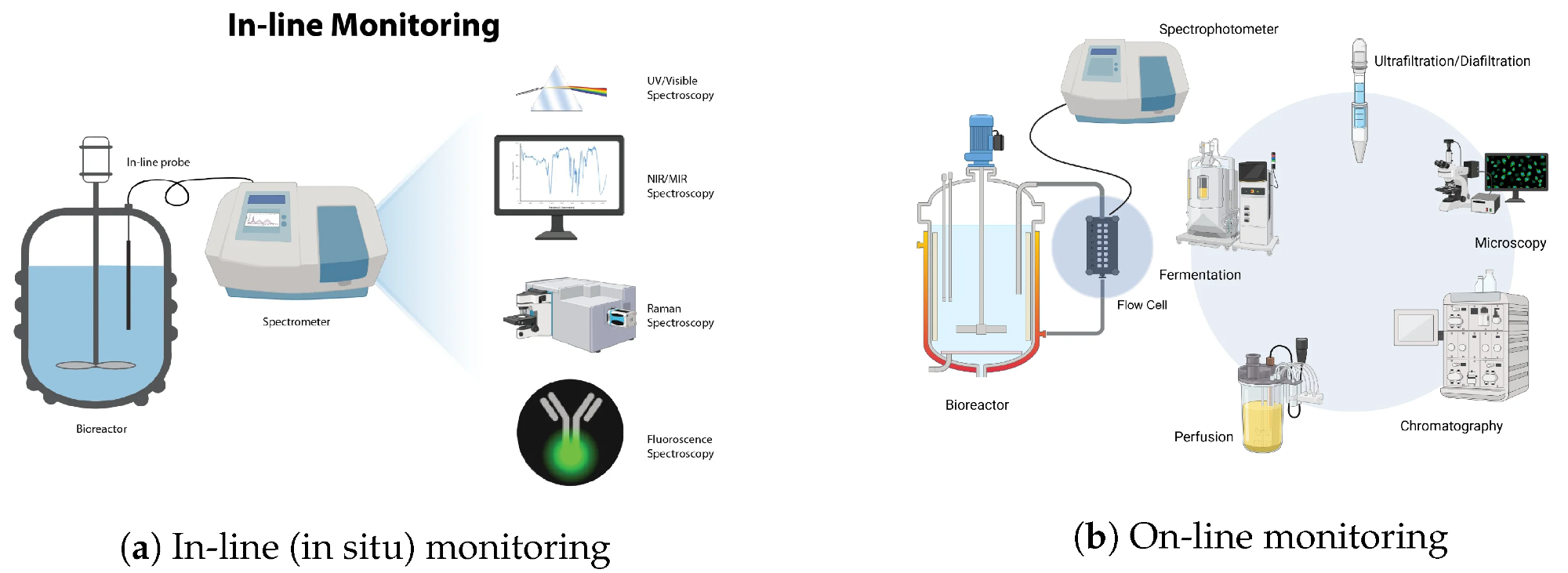
PAT measurements can be performed in in-line, on-line, or at-line configurations. In in-line measurements, the sensor is inserted directly into the process; in on-line measurements, samples are analyzed through a bypass loop; and in at-line measurements, samples are removed from the process and analyzed nearby, with automated sampling possible in some implementations. Depending on the analytical technology, frequent or continuous information on biomass composition, biomass, substrate, and metabolite concentrations can be captured to support rapid process decisions. Multiple PAT sensors (e.g., monitoring biomass, soluble and volatile biochemical compounds) can be integrated with standard process parameters (pH, temperature, dissolved oxygen).2,4
Spectroscopy Techniques Used in Modern PAT
Spectroscopic techniques are used as PAT tools because they can give quantitative and qualitative information about multiple analytes in a sample and many can be integrated into bioprocesses using flow cells or fiber optic probes. Researchers commonly use techniques such as Raman spectroscopy, near-infrared (NIR) spectroscopy, FTIR spectroscopy, and fluorescence spectroscopy.3,4
Raman Spectroscopy
Raman spectroscopy is one of the most widely used PAT techniques, with applications in both upstream and downstream bioprocessing. In upstream cell-culture applications, Raman probes and chemometric models have been used to monitor analytes including glucose, glutamine, lactate, ammonia and glutamate. Raman spectroscopy detects molecular vibrations through inelastic light scattering, allowing rapid identification of molecular composition.2-4
This method has been applied to mammalian cell culture processes and monitoring monoclonal antibody (mAb) concentrations because of its minimal water interference and high molecular specificity. By integrating Raman spectroscopy with chemometric modeling, accurate concentration predictions can be achieved. However, the technique is temperature-sensitive and has limitations in detecting low-concentration analytes because Raman scattering is inherently weak; fluorescence backgrounds can also obscure Raman signals.1,3
Near-Infrared (NIR) Spectroscopy
Researchers commonly use NIR spectroscopy (wavelength range 800–2500 nm) for biomass and nutrient monitoring, and it has also been investigated for downstream applications. This method has applications in upstream and downstream processing.1,3
NIR is sensitive to hydrogen-containing bonds, such as C─H, N─H, and O─H, and can probe water content and organic molecules in complex matrices. Combining NIR spectroscopy with Partial Least Squares (PLS) regression can provide accurate predictions of biomass and glycerol. NIR also enables high-throughput monitoring of concentration changes and compositional variability across complex bioprocesses.
While the method allows fast data acquisition and robust fiber-optic links, NIR spectra contain broad and overlapping bands, and the technique generally has lower chemical specificity than Raman or mid-infrared spectroscopy, making chemometric calibration important for quantitative applications.1
FTIR Spectroscopy
Fourier transform infrared (FTIR) spectroscopy (wavelength range from 2500 to 25,000 nm) is used and investigated for bioprocess monitoring because molecular vibrations provide chemically informative spectral fingerprints. FTIR has been used to quantify metabolites including glucose and lactic acid, although not every implementation provides direct in-line real-time measurement.1,5
When combined with data-driven algorithms, FTIR can support real-time prediction and process control. Although the method provides highly accurate structural ‘fingerprints’ for complex mixtures, conventional probe and ATR implementations can face practical limitations involving optical materials, cleaning or sterilization, environmental sensitivity, and integration into the manufacturing process.1,5
One recent proof-of-concept ATR-FTIR platform using disposable internal reflection elements distinguished nutrient-deficient from healthy CHO-cell samples and quantified glucose and lactic acid in cell-culture media. Binary prediction models produced R2 values of 0.969 for glucose and 0.976 for lactic acid, while a multi-output PLS model produced an R2 of 0.980. Importantly, the study itself focused on at-line measurements; integration of the disposable elements into bioreactors for real-time monitoring was proposed as a future development rather than demonstrated.5
Fluorescence Spectroscopy
Fluorescence spectroscopy is an attractive option for in situ monitoring due to its inherent benefits. It is non-invasive, offering high sensitivity and the capability to detect multiple components even at low concentrations. Moreover, the equipment required for this type of spectroscopy is significantly less expensive when compared to alternatives like Raman or NIR spectroscopy. Additionally, this method does not require specialized sample preparation procedures.1,4
Common applications of fluorescence spectroscopy include cellular metabolism and viability assessment. Fluorescence spectrometers can monitor cellular metabolism through intrinsically fluorescent biomolecules such as NADH, flavins, and tryptophan. However, this method can only directly detect molecules that exhibit intrinsic fluorescence, limiting its applicability to certain types of bio-molecules.1
Nevertheless, non-fluorescent process variables can sometimes be estimated indirectly through correlations between fluorescent metabolic markers and the variable of interest. Fluorescence spectroscopy has already been demonstrated for in-line monitoring in a range of laboratory-scale bioreactor studies, although industrial implementation remains comparatively limited.1 However, background fluorescence and sample conditions such as turbidity, pH and photobleaching may reduce measurement accuracy.1
Where Spectroscopy Delivers Value on the Manufacturing Floor
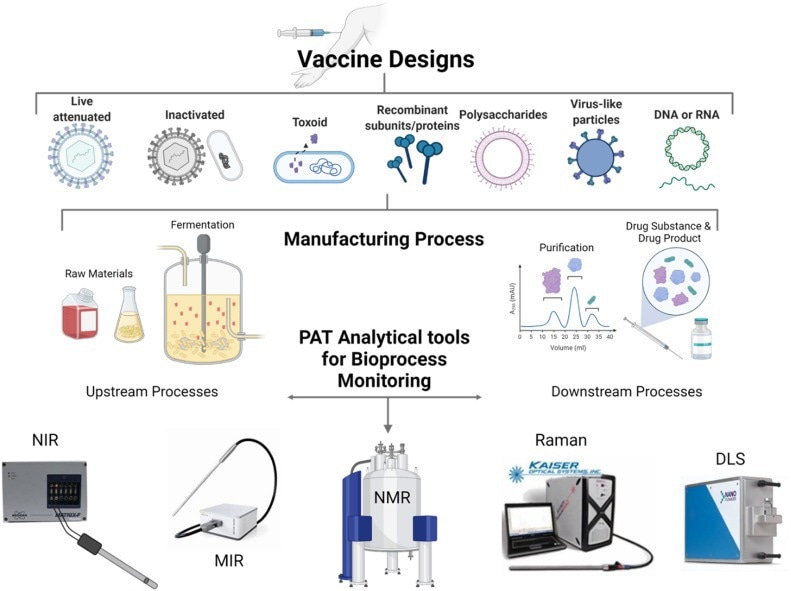
PAT systems can deliver value on the floor in terms of cell culture optimization, fed-batch control, nutrient feed automation, monitoring critical process parameters (CPPs), and providing analytical information that can support real-time release testing (RTRT). Implementing PAT analytical tools enables digitized processes with feedback-loop control, helping researchers better understand, control, and optimize bioprocesses.2,3
Digital twins are being developed as virtual representations that can simulate manufacturing processes, with potential applications in process optimization, equipment adaptation, and technology transfer across manufacturing sites. Together, these capabilities are intended to help operators respond to process deviations more quickly, reduce unnecessary interventions, and maintain consistent product quality throughout manufacturing.2,3
Integrating multiple PAT techniques into the bioprocess stream with a process monitoring system (PMS) enables automated data acquisition, visualization, and analysis. The resulting platform can support feedback and feedforward control of analytical and process instruments, contributing toward the broader goal of real-time release testing (RTRT).3
From Data Collection to Process Control
The integration of chemometric modeling and multivariate analysis can support dynamic process control. While multivariate data analysis plays a crucial role in extracting meaningful insights from the complex datasets generated in process monitoring, digital twins provide virtual representations of manufacturing processes that can be developed for prediction, simulation, and control. In biopharmaceutical manufacturing, however, digital-twin implementation remains challenging because biological processes are dynamic and not all influential process parameters are fully understood.2,3
Artificial intelligence (AI) and machine learning models, including support vector regression and neural networks, are improving predictive process monitoring. Often referred to as ‘soft sensors’, data-driven models can estimate process variables or quality attributes from correlated sensor and process data, while hybrid approaches combine such empirical models with mechanistic process knowledge.1,2
What Still Limits Adoption?
Although the results are promising, several factors still limit adoption, including calibration-model development, environmental and measurement noise, sensor or probe limitations, and the need to maintain models throughout their lifecycle. Model calibration requires extensive, representative datasets, which are often constrained by industrial limitations related to time and cost. Changes in process conditions, equipment, or raw materials can challenge model transferability, so models must demonstrate robustness and sustained predictive performance.1,2,5
Although it is widely acknowledged that a PAT framework aligned with a QbD approach is important for advancing continuous manufacturing, process control, and RTR, there is still some hesitancy to implement PAT on a commercial scale. This reluctance is largely driven by the perceived regulatory burden associated with submissions involving predictive models. Predictive models require rigorous validation and documentation for regulatory approval. This includes demonstrating their comparability, reliability, and justification for the parameters used during model development.3
Comparability between conventional analytical results and PAT-generated data may also need to be established. Technology transfer between sites and implementation costs are important barriers. Cost and performance also vary substantially by instrument and application: Raman offers high molecular specificity but typically carries higher instrumentation costs, whereas NIR offers moderate cost and broad industrial applicability at the expense of lower chemical specificity and a greater dependence on chemometric calibration.1,3
Future Directions for Spectroscopy-Based PAT
Future developments are expected to focus on hybrid modeling approaches, improved sensor designs, and automation strategies to enhance the robustness of real-time spectroscopic monitoring in pharmaceutical bioprocessing. Advances in continuous bioprocessing, single-use bioreactors, and AI-driven spectroscopy are expected to improve scalability, manufacturing flexibility, and process robustness.2,5
Despite challenges in regulatory compliance and technology integration, the use of multiparameter monitoring platforms and AI-enabled analytical innovations in automation and machine learning are helping advance the transition to intelligent manufacturing systems.2,3
With the integration of machine learning, there is potential to improve model maintenance, forecasting, and process-control decisions, provided that models remain robust, validated, and within acceptable prediction limits. Rather than eliminating conventional analytical testing outright, the emerging direction is toward integrated systems in which sensors, automated data pipelines, predictive models, and process-control strategies work together to enable more adaptive manufacturing and move closer to real-time release.1,2,3
References and Further Reading
- Mishra, A., Aghaee, M., Tamer, I. M., & Budman, H. (2025). Spectroscopic Advances in Real Time Monitoring of Pharmaceutical Bioprocesses: A Review of Vibrational and Fluorescence Techniques. Spectroscopy Journal, 3(2). DOI: 10.3390/spectroscj3020012,
- Gerzon, G., Sheng, Y., & Kirkitadze, M. (2022). Process Analytical Technologies – Advances in bioprocess integration and future perspectives. Journal of Pharmaceutical and Biomedical Analysis, 207, 114379. DOI: 10.1016/j.jpba.2021.114379,
- Sathiyapriyan, P., Mukherjee, S., Vogel, T., Essen, O., Boerema, D., Vey, M., & Kalina, U. (2025). Current PAT Landscape in the Downstream Processing of Biopharmaceuticals. Analytical Science Advances, 6(1), e70013. DOI: 10.1002/ansa.70013,
- Dambruin, N.A., Pronk, J.T. & Klijn, M.E. (2025). Application of process analytical technology for real-time monitoring of synthetic co-culture bioprocesses. Analytical and Bioanalytical Chemistry, 417, 5611–5625. DOI: 10.1007/s00216-025-05949-2,
- Christie, L., Rutherford, S., Palmer, D. S., Baker, M. J., & Butler, H. J. (2024). Bioprocess monitoring applications of an innovative ATR-FTIR spectroscopy platform. Frontiers in Bioengineering and Biotechnology, 12, 1349473. DOI: 10.3389/fbioe.2024.1349473,
Last Updated: Oct 5, 2026